
I often say that if I had a magic wand, I would ensure that every child could access the education they desire, and that school fees would never be a barrier. That wish is deeply personal to me. It comes from lived experience, from memories of struggle, and from the quiet determination of my parents—who believed in education even when paying for it was a constant challenge.
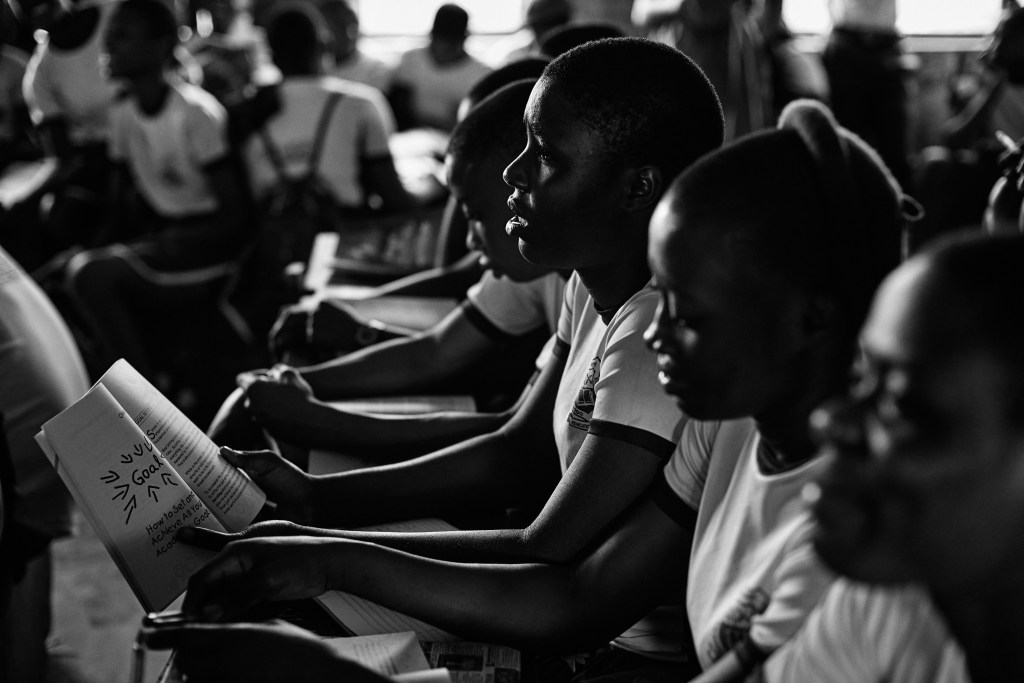
My parents were unwavering in their commitment to our schooling. They did not have much, but they had conviction. They believed that education could open doors that circumstances had closed for them. They carried that belief faithfully, even when the financial burden was heavy. Today, they are no longer with us, but their sacrifices continue to shape the way I see the world and the choices I make.
Growing up in Kiambu County, in Mang’u village, I had big aspirations. Education seemed like the clearest path towards achieving them. When I received the opportunity to attend a national school in Kenya, it felt like my wildest dream had come true.
But that joy was soon overshadowed by worry. I remember wondering whether I would be able to stay in school, whether the fees would be paid, and whether the dream would slip away just as it had begun. It was a difficult period, filled with uncertainty.
Yet, somehow, I made it.
I struggled through it—but I made it.
Those experiences stayed with me. They shaped not only my appreciation for education, but also my sense of responsibility toward others who face similar challenges. Over the years, supporting education has become one of my quiet passions. Sometimes this support has been organized with some peers who have similar values, and sometimes it has been more ad hoc, responding to a need as it arises as once off.
My focus has been on secondary school education which is quite expensive in Kenya. At times, I have worried about sustainability. I asked myself: What about tomorrow? What if I cannot continue? What if this once-off is not enough for the young lady or gentleman to finish school?
Then it struck me that life is lived one day at a time. What matters is doing what we can, when we can, with the resources available to us at that moment.
There is something profoundly moving about meeting a child or a parent who feels helpless and then witnesses gradual change over the years. Seeing a child remain in school, gain confidence, and begin to imagine a future—that is deeply fulfilling. It is a reminder that even small acts of support can create meaningful shifts in people’s lives.
Two things stand out most strongly from these experiences.
The first is the impact on parents, especially mothers. I have watched their attitudes evolve over time, often moving from anxiety and resignation towards hope. One mother once told me that she believed she had benefited more emotionally from the support than her daughters had. That statement stayed with me. It revealed the quiet burden many parents carry: the pain of wanting the best for their children yet feeling powerless to provide it.
I can only imagine the sorrow of a parent who is convinced that education could open doors for their child but lacks the means to make it possible. At the very least, education offers children structure, socialization, and the confidence to navigate life. At its best, it creates opportunities that can transform entire families.
The second thing that stands out is the message I repeatedly hear from the children themselves.
Again and again, they say:
“I want to be able to help others in the future.”
That simple statement is deeply inspiring. It amazes me how quickly this comes out from the mouths of this young people and sometimes the parents. It reflects a cycle of generosity that extends beyond the immediate moment. When people receive support, many develop a desire to give back. They carry forward the kindness they experienced, and in doing so, they multiply its impact.
This is what keeps me committed to supporting education. It is not only about school fees or academic achievement. It is about dignity, hope, and possibility. It is about breaking cycles of limitation and nurturing cycles of opportunity.
Who will walk with her?
There are many people doing work to support education in Kenya with large- and small-scale interventions, and there are some individuals like me who feel like the hummingbird as one or two students may feel insignificant. In many cases the sponsorships are for the “bright children”. I will reflect on this later, but my key question usually is “what about her or him?” What about the child who is not performing well academically, but also needs to access an education? Who will support her/him?
Education is rarely sustained by individuals alone. Behind every child who remains in school, there is often a network—parents, relatives, teachers, neighbours, and community members—each contributing in small but meaningful ways. When that network is absent, the risk of exclusion increases, particularly for children from low-income households.
This is why mentorship and community support matter.
Not every person can pay school fees, but many can offer guidance, encouragement, and time. A conversation, consistent follow-up, or simply showing interest in a child’s progress can strengthen confidence and motivation. For parents, especially mothers who often carry primary responsibility for children’s wellbeing; having someone who listens and offers practical advice can reduce isolation and restore hope.
Supporting education does not require large resources. It requires collective commitment.
Each of us can play a role.
You can mentor a child in your community.
You can check in on a struggling family.
You can share information about scholarships or training opportunities.
You can contribute—individually or as a group—to support a child’s continued learning.
Communities become stronger when responsibility for children’s education is shared. When adults invest time, knowledge, and care, children are more likely to stay in school, complete their studies, and develop the confidence to contribute positively to society.
If you are reading this, I invite you to consider one simple question:
Who is one child or young person you can support—starting today?
It does not have to be a large commitment. It only needs to be consistent. Or it can be once-off and some parent or child somewhere will feel that their prayer has been answered.
Because when communities come together to support education, opportunity becomes more accessible, and hope becomes more sustainable—for children, for parents, and for the future.
A dedication
This journey, and the values that guide it, began with my parents, the late John Ngugi and the late Mary Wambui.
They believed in education with a quiet determination that never wavered, even when the cost felt overwhelming. They carried responsibilities that were heavier than their resources, yet they chose to invest in our future. Their commitment was not expressed in grand words, but in daily sacrifices—prioritising school fees, encouraging perseverance, and reminding us that education could create possibilities beyond our immediate circumstances.
They are no longer here to witness the lives that continue to be shaped by the opportunities they fought so hard to provide. But their legacy lives on—in every child who stays in school, in every parent who regains hope, and in every small step taken towards a better future.
This work is, and will always be, a tribute to them.
To their resilience.
To their faith in education.
And to their belief that even in the face of struggle, investing in a child’s learning is never in vain.

